

72·
17 days agoWhat a fantastic article.

What a fantastic article.
Epic charges less than 30%. I think it was 10-15%. That’s their whole selling point. And when I say it is their whole selling point, I do genuinely mean it, because the platform and software itself are pretty bad compared to Steam.
Victims of capitalism tend to die from malicious or callous actions. Victims of communism, if you want to call it that, tend to just die because of incompetent leaders than anything else.

There’s nothing inherently wrong with the concept of ANPRs (automatic number plate recognition) as these are called in the rest of the world. It’s more of an issue that there is a complete lack of laws surrounding how that data is to be used, and especially when it’s controlled by a private company. If there were strict laws limiting the situations where ANPRs could be used, such as requiring a warrant to begin searching for plate numbers and automatically discarding data from non-matching plates, I doubt people would complain as much about these.

The Nintendo Switch was just taken offline in Mainland China, not that it was terribly popular anyway, because it only had around 10 games available for it.
The video game market in China has essentially been dominated by a company called Tencent for years, who are known for poor customer experiences and frustrating software. The Chinese were enshittifying online services years before the word “enshittify” was coined.

Bruh people on Lemmy say the most mind-numbing things
Yes, that’s pretty much what I said in the line of text under the graph.
Looking at the included chart (below), I don’t think the growth in “unknown” is the primary factor of Window’s decline in market share. The chart does show, over the last two data points, that Mac OS and Linux have increased at the same time that Windows has decreased.
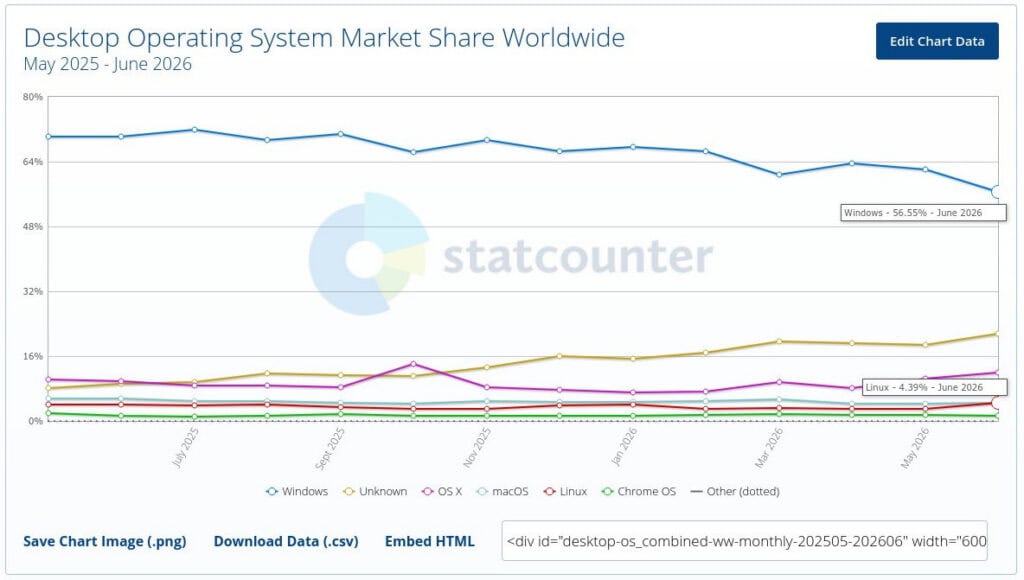
This is all but one data point anyway, so it’s not fair to draw a long-term conclusion based on that regardless.
Urban Dictionary for people who actually want to know what words mean
In my opinion Wiktionary is probably the best English dictionary on the planet and probably the best English to other language dictionary as well.
It seems like others have already given the definition, but I do want to introduce you to the wonderful thing that is Wiktionary.

https://en.wiktionary.org/wiki/haul_ass
It’s part of the same project as Wikipedia, and it has a very comprehensive compendium of definitions for slang terms.
I initially thought this was Wikipe-tan. The design is quite similar.

The collection of texts today known as the Bible were not written at once. There’s actually a lot of interesting history about how it came to be, but the short of it is that there were a multitude of maybe-canon Christian texts floating around during the early period of Christianity. These texts were written decades or even centuries apart, and often falsely attributed to authors who did not write them. There was also the Septuagint, a Greek text which was a translation of various Jewish scriptures, many of which now form the Old Testament.
The early Christian church decided which of these were deemed to be canon and which were non-canon. The canon texts were compiled together to form what is now the Bible. Everything else that was deemed not canon is called the Apocrypha. Many of these texts were also deemed heretical or blasphemous to read, publish, or teach by the various ecumenical councils.
Each Christian denomination has a slightly different version of the Bible depending on which decisions and ecumenical councils they accept.
The most interesting difference would be the Bible of the Church of Jesus Christ of Latter-Day Saints (also known as the Mormon Church), which has an additional text called the Book of Mormon. That was written in the 19th century by a guy named Joseph Smith, an American religious leader who founded Mormonism. According to Mormon theology, it contains the revalations he received from God about various other unknown saints who lived in America and other holy happenings which took place, making the US a second holy land of sorts. His group travelled to the western United States to find their own promised land and establish a Mormon theocracy (they were successful; it’s now the US state of Utah).
There’s no historical evidence that any of these texts were intended to be read as anything other than religious scripture, but keep in mind that in Biblical times, people seemed to have had a really difficult time differentiating texts written by people having fever dreams versus actual genuine accounts of observed events or legitimate attempts to write scripture. If you want a fun time, you can read some of the Apocrypha, which are often similar in style to the canonical gospels but are slightly… weirder. The line between religion and insanity was not so easily found back then. Regardless of their authors’ original intent, the Apocrypha certainly can be read for entertainment in the 21st century.
I think there is a line to be drawn between what is theoretically better and what is meaningfully useful.
It is realistically not useful information for an attacker to know what country you are from by observing your UTC offset. It’s simply much easier to guess this information by observing your other behaviours. For example, the text and time of your post is already leading me to guess UTC+5:30 as the time zone in question. But again, knowing what country you’re from is not really useful information most of the time, as even if my guess is correct, that narrows it down to a whopping one-eighth of the human population.
Like the others have said, all major distros are fine. Ubuntu is or used to be Valve’s “favourite distro” and the package that you can get from Valve’s website is for Ubuntu. That being said, software on Linux should be installed using the package manager (the Software Centre) and not downloaded from the Web.
You may wish to upgrade to Ubuntu 24.04 LTS later. This is fairly easy (you can use the Software Updater application) but the newer versions have better drivers and newer GNOME versions which may bring better performance.
Arch is the one thing that should be absolutely not recommended to beginners. Even implying that it is a suitable beginner distro in any way like you have done in this comment is only likely to drive away users when they inevitably get confused.
Existing Windows users mostly are not interested in even knowing of the existence of the Arch Wiki. They will just give up and conclude Linux is shit.
Flathub is almost the perfect distribution system for software on Linux. The only thing it’s missing is a billing system. If it had that, it would probably attract more game developers to make their games available as Flatpaks.

Look no further than the dissent to United States v. Wong Kim Ark (when the Supreme Court ruled that the passage you cited grants citizenship by birthright), written by Chief Justice Melville Fuller, the mastermind behind such legal opinions as:
Anyway, he wrote:
the children of Chinese born in this country do not, ipso facto, become citizens of the United States unless the fourteenth amendment overrides both treaty and statute
and
[Birthright citizenship means] the children of foreigners, happening to be born to them while passing through the country, whether of royal parentage or not, or whether of the Mongolian, Malay or other race, were eligible to the presidency, while children of our citizens, born abroad, were not.
So in other words, he was willing to rule that the constitution is optional as long as you are using it against undesirable races in order to get his way.

It’s not just for decoration. You can use it as a legitimate pointing device. Nudging it will move the mouse cursor and tapping it with your fingernail is clicking.
It takes some getting used to but you can definitely use it for normal office tasks if you wanted to. That being said, I still personally prefer a mouse. But I have known some people who like using the nipple.

I never understood why console players always get so worked up about exclusives. People say the stupidest most absolutely nonsensical things like “the PS5 has no games”. What the hell do you mean?? The PS5 has lots of games, you’re just salty that other people can play those games too. Why can’t people just be happy that more people can enjoy the games? They have to have that feeling of superiority I suppose